If Attention deficit hyperactivity disorder (ADHD) and migraine have similar characteristics, are they connected? It is a question I hear a lot in the community and it is worth talking about. Because the research says yes.
I do not have ADHD, so this blog is not written from personal experience. But it is rooted in research and science, and in the number of people in this community who are navigating both and wondering why nobody ever connected the dots for them.
The Numbers Are Hard to Ignore
Multiple studies, across children and adults, have found that migraine and ADHD show up together far more often than you would expect by chance. People with ADHD are more likely to have migraine. People with migraine are more likely to have ADHD. A 2018 study of over 26,000 adults found that adults with ADHD were almost twice as likely to report migraine compared to those without ADHD.
An earlier Norwegian study looked specifically at adults diagnosed with ADHD and found that 28.3% of them had migraine, compared to 19.2% in the general population. Research has found a clear link between ADHD and migraine specifically, but not between ADHD and other types of headache disorders. That matters because it points to something particular about the way the migraine brain works.
It also starts early. A study of over 5,000 children found that kids with migraine were significantly more likely to have ADHD than kids with other headache disorders or no headache at all. And the more frequent the migraine attacks, the stronger the link. The research also consistently shows the overlap is even more pronounced in people who experience migraine with aura, though exactly why that subtype shows a stronger connection is still being studied.
These findings come from large, carefully conducted studies across multiple countries. This is not a theory, it is a connection.
Why Would These Two Things Be Connected?
Researchers are still working out exactly why. What follows is where the evidence currently points, not a definitive answer. But the patterns are consistent enough that they are worth understanding.
One piece of it is brain chemistry. Both migraine and ADHD involve how the brain handles dopamine, the chemical that affects things like focus, motivation, and how we experience reward and pain. In ADHD, the brain has a harder time regulating it. In migraine, shifts in dopamine are also thought to be involved in why attacks happen and how pain is processed. The fact that both conditions involve this same system is one reason researchers think they may share more common ground than their surface symptoms suggest.
Both are also strongly influenced by genetics. They run in families, and research has found that people with ADHD are more likely to have relatives with migraine. The overlap appears to be built in at the level of how the brain is wired.
There is also a shared pattern in how both brains experience the world. The migraine brain is more reactive to input. Light hits harder, sound feels louder, smell is more overwhelming, change is more disruptive. Many people with ADHD describe a similar kind of sensory experience. Research has also found that both conditions involve the nervous system, specifically the part that controls things like heart rate and stress response, functioning differently than average. Two different diagnoses, but some of the same underlying wiring.
None of this is the full picture yet. But what is already clear is that these are not two completely separate things happening in the same person by coincidence.
From our shop
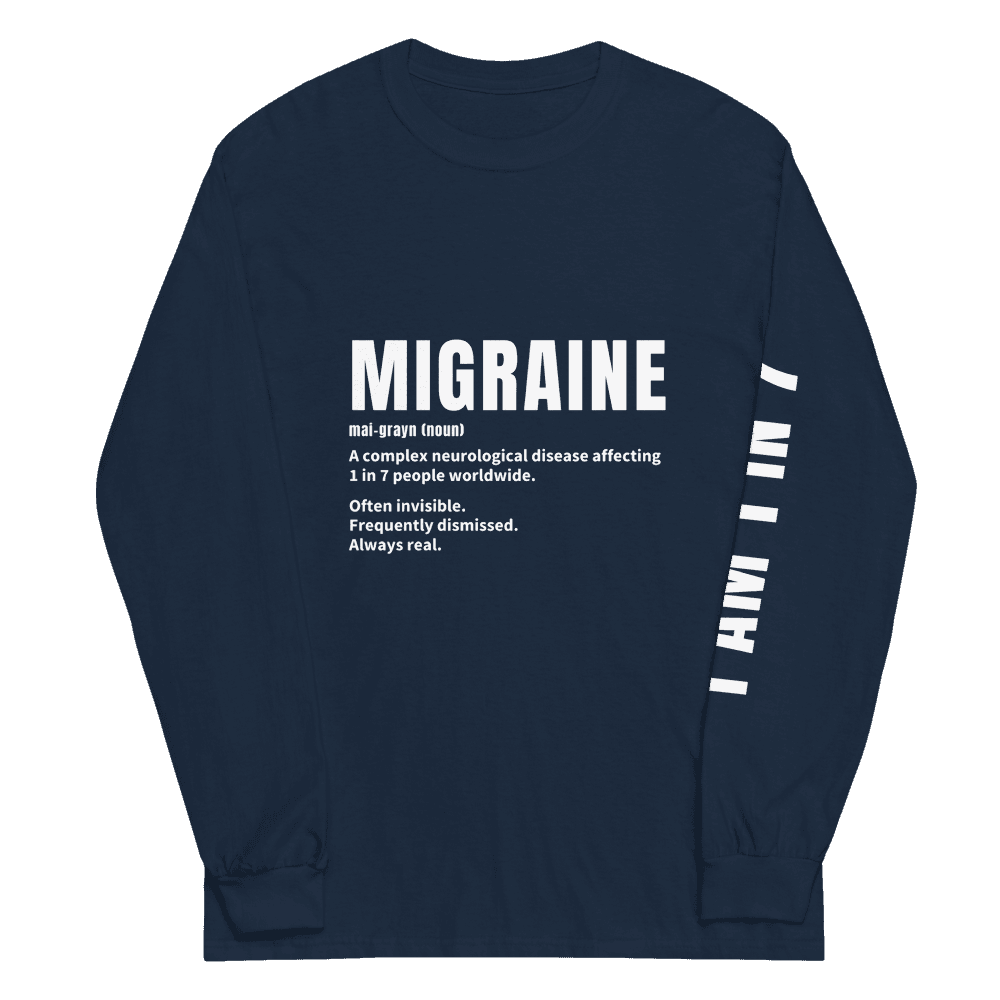
Migraine Definition Sweatshirt
Shop nowDesigned by The Migraine Network 💜
How ADHD Can Fill the Migraine Cup Faster
Beyond what is happening in the brain, ADHD creates real daily patterns that directly make migraine harder to manage.
Think about the cup. Every day your nervous system fills with triggers and stressors. When the cup overflows, a migraine attack begins. ADHD does not just share some neurological ground with migraine. It also makes it genuinely harder to maintain the things that keep the cup from filling so fast.
Keeping a consistent sleep schedule is one of the most powerful ways to protect migraine threshold. It is also one of the hardest things for someone with ADHD. A brain that races at night, wakes frequently, or struggles to wind down on a regular schedule is a brain whose cup starts each day already fuller than it needs to be.
Then there is eating. Many people with ADHD experience something called time blindness, where hours pass without noticing. You look up and realize you forgot to eat lunch, or it is 3pm and you have had nothing since breakfast. Going too long without eating is one of the most reliable ways to lower migraine threshold, and for someone with ADHD, it happens without any intention for it to. It is also worth knowing that stimulant medications commonly prescribed for ADHD can suppress appetite, which makes this pattern even easier to fall into without realizing it.
Add to that the mental load. Managing ADHD takes real effort. The constant work of staying organized, regulated, and on top of things is a form of stress that does not always look like stress from the outside. But the nervous system feels it. And that ongoing load adds to the cup, often without a clear way to drain it.
None of this means migraine is caused by ADHD. It means that for someone carrying both, the cup fills faster and in more directions. The threshold framework becomes especially important in that context. If you want to learn more about how threshold works and what you can do about it, I go deeper in my blog Understanding Migraine Threshold: How to Raise It and Why It Matters.
If migraine and ADHD are both part of your life, the most useful thing you can do is stop treating them as two completely separate problems. Tell both sets of providers about both conditions. Track sleep, meals, stress, and attack timing together so patterns have a chance to become visible. And know that managing ADHD well, whatever that looks like for you, is not separate from managing migraine. It is part of the same work.
Two conditions that the medical world often treats as unrelated. But your nervous system has always known they were not.
This article is for educational purposes only and is not medical advice. It is not a substitute for professional diagnosis or treatment. Always talk with a qualified healthcare provider before making changes to your care, medications, or supplements.
Written by Deena Migliazzo
Migraine advocate, educator, and founder of The Migraine Network. Living with chronic migraine and dedicated to building community, education, and resources for others who get it.
Learn more about Deena